
Background
The parties are engaged in several on-going arbitrations and pieces of litigation arising from their business in Mainland China and internationally. W, the Claimant in a Hong Kong seated HKIAC arbitration, had successfully sought and obtained an Interim Award on Emergency Measures (Emergency Award) from an Emergency Arbitrator appointed under the HKIAC 2024 Rules [s23; Sched 4]. The Emergency Award took the form of injunctive relief enforcing the Respondent’s compliance with various provisions of a Framework Agreement (GFA) between the parties; in particular, various non-compete and non-solicitation obligations.
In light of the Respondent’s continuing breaches of the GFA and of the Emergency Award, the Claimant sought and obtained, on an ex parte basis, an Order from the Court under s22B of the Arbitration Ordinance (Cap 609) (AO) granting leave to the Claimant to enforce the Emergency Award as if it were an order of the Court (Enforcement Order).
Respondent’s Set-Aside Application
The Defendant then issued a summons under O73 r10(6) RHC seeking to set aside the Enforcement Order (Set Aside Summons). The Set Aside Summons cited, amongst other provisions, ss81 and 89 AO. Consistent with those provisions, the grounds relied upon by the Respondent were that:
1) the GFA (including its arbitration clause) was invalid for want of authority, self-dealing, improper purposes and abuse of process such that the Emergency Arbitrator lacked any jurisdiction to make the Emergency Award;
2) the Respondent had been denied a fair hearing by the Emergency Arbitrator in relation to corrections to the Emergency Award; and
3) the Emergency Award was contrary to Hong Kong public policy insofar as it affected non-parties and enforced unreasonable restraints on trade.
Claimant’s Opposition
The Claimant opposed this and contested, as a preliminary point, that the Set Aside Summons was fundamentally misconceived in that all the grounds relied upon by the Respondent were grounds applicable to the setting aside of a substantive or final arbitration award which decided the merits of a dispute, but had no application to the setting aside of an Emergency Award.
In that regard it was contended for the Claimant that:
1) the Emergency Award was not in any sense final, in that it only operated at the discretion of the properly appointed Tribunal in the underlying arbitration and, at most, until the making of a final award. Thus, ss81, 86 and 89 (and the grounds therein) could have no application;
2) the factorial approach set out by Cockerill J in ZCCM Investment Holdings v Kansanshi Holdings [2019] 1 CLC 770 fully supported the non-finality of the Emergency Award;
3) it mattered not that the decision was termed an ‘Award’ given that substance should prevail over form in the analysis;
4) the only grounds for set aside (apart from material non-disclosure at the ex parte stage) were to be found in s22B AO, and were limited in scope reflecting the legislative intent of minimal curial intervention on such matters;
5) in that regard, the Emergency Award was akin to an Interim Order which could be enforced under s61 AO, and thus the reasoning in G v N [2024] 4 HKC 1 on setting aside such orders was by analogy applicable; and
6) the earlier case of GD v HY [2021] HKCFI 3900 should be reassessed as the present arguments were not raised before the Court at that time. Insofar as that case can be read as treating the grounds for setting aside a substantive award (now found in s81 AO) as applicable to the setting aside of an Emergency Award, it should, with respect, be treated as incorrectly decided. Instead, the outcome of GD v HY could be taken as founded upon the separate equitable principle against futility i.e. that the Court does not act in vain and that, if there is a plain and obvious lack of jurisdiction in the arbitrator, the Court will not grant or continue an enforcement order for the award. In contrast, on the facts here there was a clear prima facie case for a valid arbitration agreement in the GFA.
Court’s Indication and Outcome
During the course of the hearing the Judge in charge of the Construction and Arbitration List indicated her agreement that the Emergency Award should be viewed as non-final and thus that ss81, 86 and 89 AO had no application.
Faced with the Court’s indication, the Respondent withdrew its Set Aside Summons and the costs of this were awarded to the Claimant on the indemnity basis.
It is also of interest that the Judge granted a short interim stay of the Enforcement Order (albeit that costs of the stay were payable by Respondent to the Claimant) given that the Respondent was also challenging the Emergency Award before the Tribunal in the underlying arbitration, with this challenge due to be heard shortly.
Takeaways / In conclusion:
This decision provides helpful clarification on the treatment of emergency arbitrator relief under Hong Kong law. It underscores the Court’s willingness to recognise and enforce Emergency Awards as a distinct, non-final form of relief, with correspondingly limited grounds for judicial interference. Attempts to deploy the more expansive set-aside grounds applicable to final awards will not succeed. While the Court’s grant of a short stay of enforcement may cause debate, the case reinforces that Emergency Awards can be a powerful and enforceable tool in Hong Kong arbitrations.
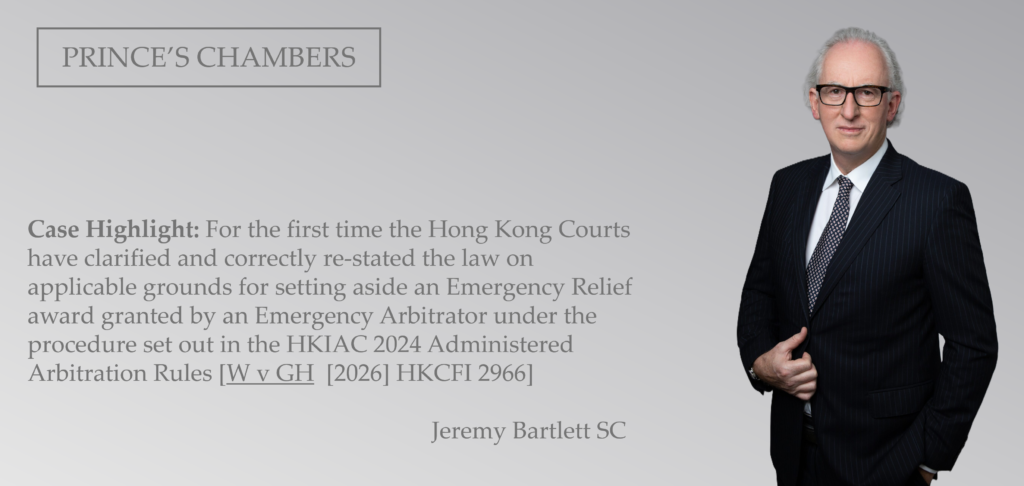
Jeremy Bartlett SC appeared for the successful plaintiff. For more information on the enforcement of emergency arbitrator awards and related injunction relief in Hong Kong, please contact Jeremy.
Read the full case here.